
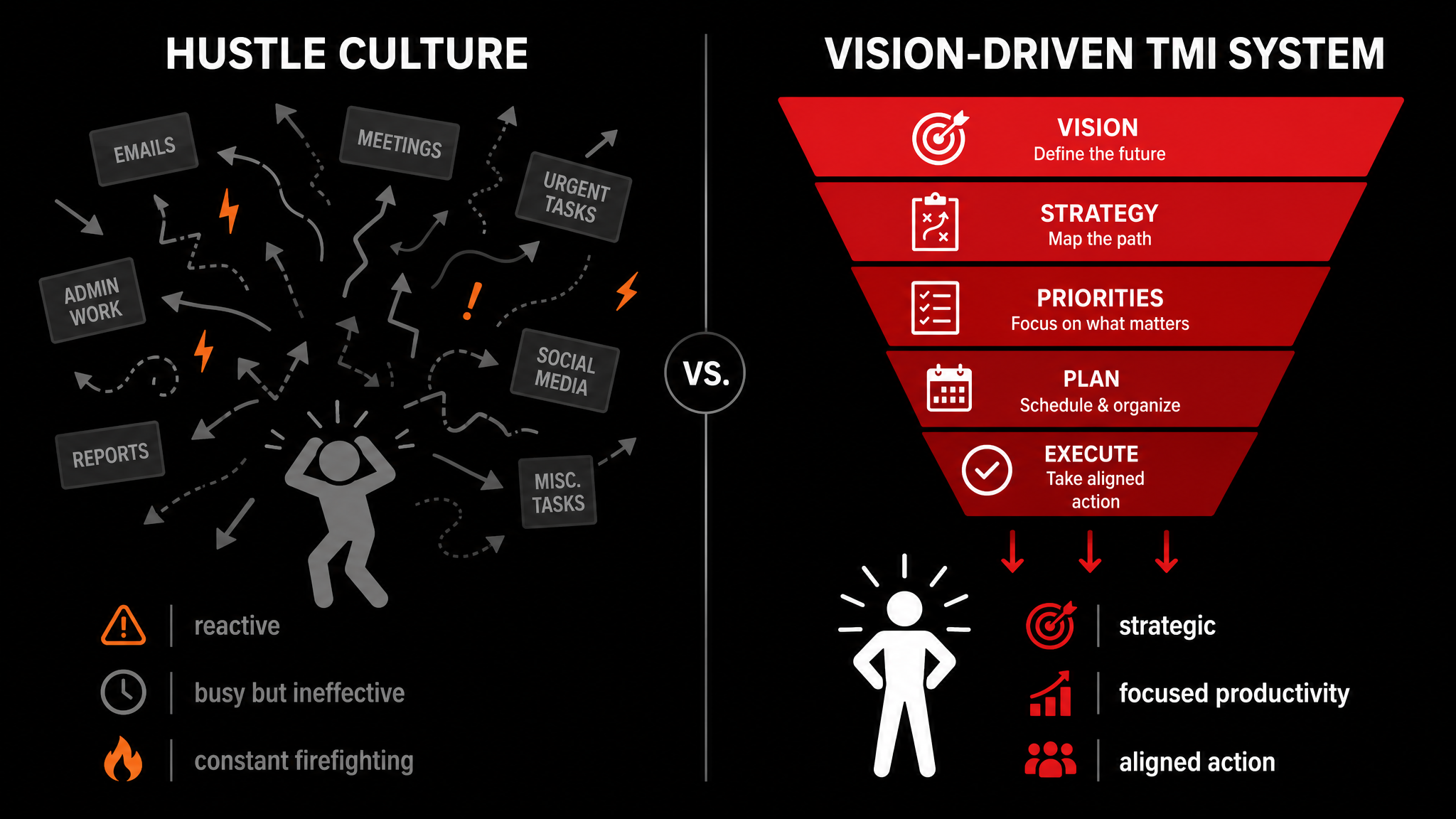
Most entrepreneurs don’t have a time management problem. They have a vision problem.
I know because I lived it. For years, I ran businesses the way most founders do – reacting to whatever screamed loudest, grinding through 14-hour days, and convincing myself that “busy” meant “productive.”
It took burning out, rebuilding, and finally developing a system that actually worked before I understood the real issue.
Time management consulting for entrepreneurs isn’t about squeezing more tasks into your day. It’s about making sure the tasks you’re doing actually matter.
That’s the core of the Time Management Inverted (TMI) system – and it’s the foundation of every consulting engagement I run at 365 to Vision.
Why Traditional Time Management Fails Entrepreneurs
Here’s what nobody tells you about most productivity advice: it was designed for employees, not founders.
Traditional time management starts at the bottom. Block your calendar. Batch your emails. Prioritize your daily to-do list. These tactics work fine when someone else defines your objectives. But when you’re the one setting the direction, starting with daily tasks is like building a house from the roof down.
According to the Harvard Business Review, CEOs spend only 28% of their time on strategic thinking. The rest gets consumed by meetings, emails, and operational firefighting. For entrepreneurs running leaner operations, that number is often worse.
The problem isn’t discipline. It’s architecture. Your time management system is built backward.
What Time Management Consulting Actually Looks Like
When I work with entrepreneurs through 365 to Vision consulting, we don’t start with calendars or apps. We start with one question:
What does your life look like in 10 years?
Not your business. Your life. Because if your business strategy doesn’t serve your life vision, you’ll build something that traps you rather than frees you.
From there, we work through the five levels of the TMI system:
Level 1: LIFETIME Vision
This is the foundation everything else sits on. We define what success actually means to you – not what LinkedIn says it should mean, not what your competitors are chasing. Your version.
Level 2: AS NEEDED Goals
These are the big milestones that don’t fit neatly into a calendar but move you toward that lifetime vision. Think: launching a new revenue stream, exiting a partnership, or restructuring your team.
Level 3: MONTHLY Objectives
Now we start getting tactical. Monthly objectives break those bigger goals into 30-day sprints that maintain momentum without creating overwhelm.
Level 4: WEEKLY Priorities
Each week gets structured around the 3-5 priorities that move the monthly needle. Not 15 priorities. Not everything that lands in your inbox. The vital few.
Level 5: DAILY Actions
Only after all four levels above are defined do we touch your daily schedule. And when we do, every task on that list has a direct line back to your lifetime vision.
This is what separates time management consulting from time management tips. Tips give you tactics. Consulting gives you architecture.
The 5 Signs You Need Time Management Consulting
Not every entrepreneur needs a consultant. But if any of these hit close to home, it’s worth a conversation:
1. You’re Busy But Not Growing
Revenue has plateaued. You’re working harder than ever, but the numbers aren’t moving. This usually means you’re spending time on $15/hour tasks while ignoring $1,500/hour decisions.
2. You Can’t Disconnect
Vacations feel impossible. Weekends blur into workdays. Your business runs on your presence rather than your systems. That’s a structural problem, not a willpower problem.
3. Your Team Lacks Direction
If your people constantly need you to make decisions, your vision hasn’t been translated into a framework they can execute against. Time management consulting addresses this by cascading your TMI structure into team-level systems.
4. You Start Every Day Reactive
Opening your inbox before defining your priorities is the fastest way to work on everyone else’s agenda. If your mornings start with “what’s on fire?” instead of “what moves the vision forward?” – that’s a red flag.
5. You’ve Tried Everything and Nothing Sticks
Pomodoro, Getting Things Done, time blocking, Eisenhower Matrix – you’ve read the books and downloaded the apps. Nothing lasts because none of it connects to a bigger purpose. The TMI system solves this by anchoring tactics to vision.
How TMI Consulting Delivers Results
I’ve worked with entrepreneurs across industries – from marketing strategy to sales productivity to leadership development. The specific applications vary, but the results follow a pattern:
Within 30 days: Entrepreneurs report reclaiming 5-10 hours per week by eliminating tasks that don’t connect to their vision.
Within 90 days: Team alignment improves measurably. Meetings get shorter. Decisions get faster. Revenue-generating activities get more attention.
Within 6 months: The business starts running with less founder dependency. Systems replace scrambling. Growth becomes intentional rather than accidental.
These aren’t theoretical projections. They’re patterns I’ve seen repeatedly because the system is built on how high-performers actually operate – not how productivity bloggers think they should.
What Makes TMI Different From Other Consulting Approaches
Most productivity consultants hand you a framework and wish you luck. The TMI approach is different in three critical ways:
It’s Top-Down, Not Bottom-Up
Every other system starts with daily habits and hopes they compound into something meaningful. TMI starts with your lifetime vision and reverse-engineers the daily actions that serve it. The difference in outcomes is massive.
It’s Built for Entrepreneurs, Not Employees
The TMI system was born from running businesses, not studying them in a lab. It accounts for the chaos, the pivots, the competing priorities that define entrepreneurial life. As noted by Entrepreneur Magazine, the ability to adapt planning frameworks to unpredictable environments is what separates successful founders from struggling ones.
It Integrates Life and Business
Most systems treat work productivity and personal fulfillment as separate domains. TMI treats them as one system because for entrepreneurs, they are one system. Your fitness, relationships, and mental health aren’t separate from your business performance – they fuel it.
Getting Started With Time Management Consulting
If you’re ready to stop managing time and start managing vision, here’s how to take the first step:
- Read the book. Time Management Inverted lays out the complete TMI framework. Grab a copy on Amazon and start building your five-level structure.
- Assess where you are. Be honest about which of the five signs above apply to you. The gap between where you are and where you want to be defines the consulting engagement.
- Book a consultation. Every engagement starts with a conversation about your vision – not a sales pitch about my services. If we’re a fit, we build from there.
Time management consulting for entrepreneurs isn’t a luxury. It’s the difference between building a business that serves your life and building a life that serves your business.
Contact me today and let’s build the system your business actually needs.
FAQs
What does a time management consultant do for entrepreneurs?
A time management consultant helps entrepreneurs restructure how they allocate their time by connecting daily actions to long-term vision. Instead of teaching generic productivity hacks, a good consultant builds a personalized system – like the TMI framework – that aligns your schedule with your actual goals, eliminates low-value activities, and creates sustainable work patterns.
How is the TMI system different from traditional time management?
Traditional time management starts with daily tasks and works up. The TMI system starts with your lifetime vision and works down through five levels: Lifetime, As Needed, Monthly, Weekly, and Daily. This top-down approach ensures every daily action connects to a meaningful long-term objective rather than just clearing a to-do list.
How long does it take to see results from time management consulting?
Most entrepreneurs I work with start reclaiming 5-10 hours per week within the first 30 days. Within 90 days, team alignment and decision-making speed improve noticeably. The full impact – reduced founder dependency, intentional growth, genuine work-life integration – typically unfolds over 3-6 months.
Is time management consulting worth it for solopreneurs?
Absolutely. Solopreneurs often need it more than larger teams because they wear every hat. The TMI system helps solopreneurs identify which activities generate the most value and which should be delegated, automated, or eliminated entirely. The return on investment usually shows up as both reclaimed time and increased revenue.
Can I implement the TMI system on my own?
Yes. The Time Management Inverted book provides the complete framework for self-implementation. Many entrepreneurs start with the book and then pursue consulting for personalized guidance, accountability, and help cascading the system across their teams.
What industries does time management consulting work for?
The TMI framework is industry-agnostic because it’s built on universal principles of vision alignment and priority management. I’ve worked with entrepreneurs in professional services, e-commerce, SaaS, consulting, real estate, and manufacturing. The specific applications change, but the architecture stays the same.
How much does time management consulting cost?
Consulting engagements vary based on scope, duration, and whether they include team-level implementation. Contact me directly for a conversation about your specific situation and goals. Every engagement starts with understanding your vision before discussing investment.