You’ve tried Getting Things Done, David Allen’s best-seller on time management. You’ve tried time blocking. You’ve installed Notion, Todoist, and three other apps you forgot you’re paying for.
Maybe you even read The 7 Habits of Highly Effective People by Stephen R. Covey twice (or 12 times like me).
And you’re still overwhelmed.
Here’s the thing: those systems aren’t bad. They’re just incomplete, especially for business owners. They optimize how you manage tasks without questioning whether those tasks should exist in the first place.
The best productivity system for business owners doesn’t start with your to-do list. It starts with your life.
That’s the premise behind the Time Management Inverted (TMI) system, and after years of building businesses, burning out, rebuilding, and finally getting it right, I can tell you why it works when everything else didn’t.
Why Most Productivity Systems Fail Business Owners
Let me be direct about this: most productivity systems were designed for a world that doesn’t look like yours.
They Assume Predictable Days
Time blocking works beautifully if you control your calendar. But many business owners don’t. A key client calls with a crisis. A supplier misses a delivery. Your best employee puts in notice. The elegant time blocks you built at 6 a.m. are rubble by 10 a.m. TMI relies heavily on time blocking, but you must be able to realign quickly when things go sour (and they often do!).
They Treat Productivity as Task Completion
Getting Things Done is a masterclass in capturing and processing tasks. But business owners don’t need help processing tasks. They need help choosing which tasks matter. GTD treats all inputs equally. Your business can’t afford to.
They Ignore the Vision Layer
The Eisenhower Matrix sorts tasks by urgency and importance. But “important” according to what? Without a defined lifetime vision, importance becomes subjective, and usually defaults to whatever generates the most anxiety.
They Separate Work and Life
For business owners, there is no clean separation between professional and personal productivity. Your health affects your decisions. Your relationships affect your resilience. Your financial habits affect your risk tolerance. Any system that treats work as an isolated domain misses half the picture.
The TMI System: Built by a Business Owner, for Business Owners
I didn’t develop the Time Management Inverted system in a laboratory or a consulting firm. I built it while running businesses, managing teams, and trying to figure out why working 70-hour weeks wasn’t producing proportional results.
The breakthrough was simple but counterintuitive: stop managing time from the bottom up and start from the top down.
Here’s the complete TMI architecture:
Level 1: LIFETIME – Your North Star
Every other system skips this step, and that’s why they fail. Before you plan a single week, you need to answer: what does a successful life look like for you?
Not a successful quarter. Not a successful year. A successful life.
This isn’t abstract goal-setting. It’s specific and personal. Where do you live? What does your health look like? How much time do you spend with family? What does your business produce? How much does it require from you?
Your lifetime vision is the filter through which every other decision passes.
Level 2: AS NEEDED – Big Moves Without Arbitrary Deadlines
These are the significant transitions your business and life must make to reach your lifetime vision. They might take 6 months or 6 years – the point is they don’t fit into quarterly planning cycles.
Examples for business owners:
- Building a management team so you’re not the single point of failure
- Developing a second revenue stream for diversification
- Creating systems that let you take a month off without revenue dropping
- Writing the book, launching the podcast, or building the personal brand
These goals live on your radar permanently until they’re accomplished. They don’t get “rolled over” to next quarter – they get advanced whenever opportunities align.
Level 3: MONTHLY – Strategic Sprints
Each month, you select 2-3 objectives that advance your As Needed goals. Monthly planning is where strategy meets execution.
The key discipline at this level: constraint. You’re choosing 2-3 objectives, not 10. Business owners who try to advance everything simultaneously advance nothing meaningfully. Focus creates momentum.
Level 4: WEEKLY – The Power of Three to Five
Your weekly plan contains the 3-5 priorities that advance your monthly objectives. These priorities get your best energy, your most protected time, and your deepest attention.
According to Stanford research on cognitive load, human decision-making quality degrades significantly beyond 5-7 active priorities. The TMI system respects this cognitive reality by forcing selection rather than accumulation.
Level 5: DAILY – Execution With Purpose
Your daily plan now writes itself. Each action connects to a weekly priority, which connects to a monthly objective, which connects to an As Needed goal, which connects to your lifetime vision.
No task exists in isolation. No day feels aimless. No week ends with the sinking feeling that you were busy but unproductive.
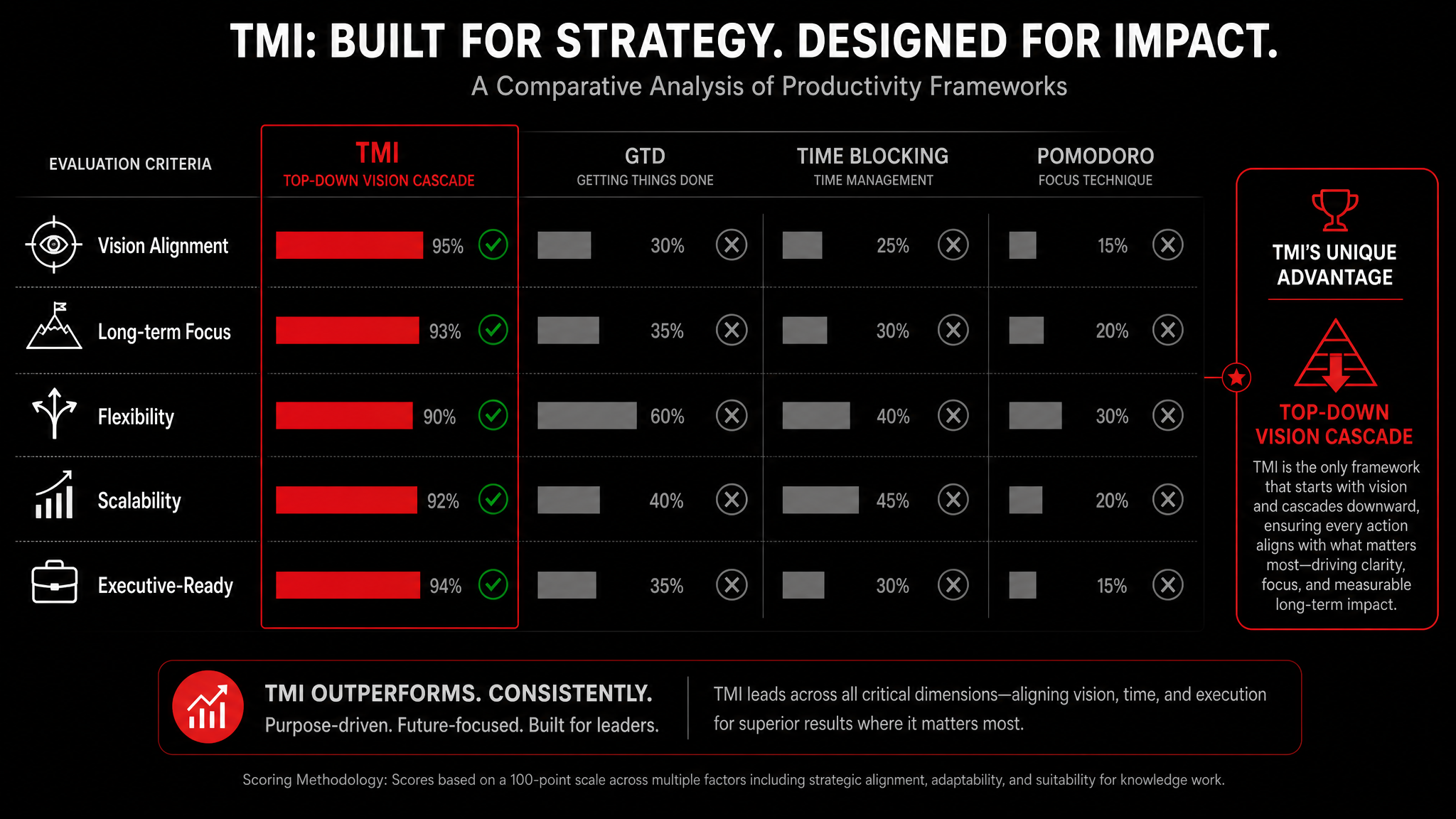
TMI vs. Popular Productivity Systems: An Honest Comparison
I respect other systems and have studied them for decades. I still continue to study them; it’s an obsession. Many contain useful tactical ideas. But business owners need to understand the differences:
TMI vs. Getting Things Done (GTD)
- GTD’s strength: Capturing and processing inputs systematically.
- GTD’s weakness for business owners: It doesn’t prioritize based on vision. Everything gets processed with equal weight. Business owners drown in well-organized mediocrity.
- TMI’s advantage: Vision-first architecture ensures only strategically relevant tasks consume your attention.
TMI vs. Time Blocking
- Time blocking’s strength: Creating dedicated focus periods.
- Time blocking’s weakness for business owners: It’s fragile. One disruption cascades through the whole day. Business owners face constant disruption.
- TMI’s advantage: Priority-driven rather than schedule-driven. When disruptions hit, you know exactly which tasks to protect and which to release.
TMI vs. The Eisenhower Matrix
- Eisenhower’s strength: Distinguishing urgent from important.
- Eisenhower’s weakness for business owners: “Important” remains undefined without a vision framework. Important according to whom? Important for what?
- TMI’s advantage: Importance is defined by alignment to your lifetime vision. No ambiguity. No debate.
TMI vs. OKRs
- OKRs’ strength: Organizational alignment and measurable objectives.
- OKRs’ weakness for business owners: They’re quarterly by default, which misses the longer-term strategic layer. They also don’t address personal vision or work-life integration.
- TMI’s advantage: TMI provides the personal leadership structure that makes OKRs effective. They work together beautifully – OKRs for the organization, TMI for the leader.
Real-World Application: What TMI Looks Like in Practice
Let me walk you through how this works for a typical business owner I might work with through 365 to Vision consulting:
- LIFETIME Vision: Build a $3M professional services firm with a team of 12, working 40 hours/week, taking 6 weeks vacation annually, while maintaining a daily fitness practice.
- AS NEEDED Goal (current focus): Hire and develop a Director of Operations to take over day-to-day management.
- MONTHLY Objective (this month): Finalize the Director of Operations job description, compensation structure, and begin recruiting through 3 channels.
- WEEKLY Priority (this week): Complete the job description with input from the leadership team and post on two recruiting platforms.
- DAILY Action (today): Spend 90 minutes drafting the job description during peak morning energy. Delegate platform research to the HR coordinator.
See how every level connects? Today’s 90-minute block isn’t just a task; it’s a direct step toward a life where this owner works 40 hours and takes 6 weeks off. That connection creates motivation that no to-do list can match.
Why Business Owners Specifically Need TMI
Business owners occupy a unique position in the productivity landscape:
- You set the direction. Employees follow priorities set by others. You set the priorities. Without a system that starts with vision, your priorities default to whatever’s loudest.
- You can’t separate roles. You’re the CEO, the head of sales, the HR department, and the IT helpdesk – sometimes all before lunch. TMI provides a unified framework that spans every role because they all serve one vision.
- Your business reflects your systems. A Forbes analysis noted that small business performance correlates directly with the founder’s personal effectiveness. Your productivity system isn’t just personal – it’s organizational infrastructure.
- You carry the risk. Bad days for employees are frustrating. Bad quarters for business owners are existential. The stakes demand a system that consistently directs your limited time toward the highest-impact activities.
This is why my consulting practice covers leadership development, marketing strategy, and sales productivity through the TMI lens. Each area requires the same top-down, vision-driven approach to produce sustainable results.
How to Implement TMI Starting This Week
You don’t need to wait for a consulting engagement to start. Here’s your implementation roadmap:
This Weekend: Build Levels 1-2
Set aside 2 hours in a quiet space. Define your lifetime vision with as much specificity as you can. Then identify 3-5 As Needed goals that represent the major milestones between now and that vision.
Monday Morning: Set Level 3
Choose 2-3 monthly objectives for the remainder of this month. They should directly advance one of your As Needed goals.
Monday Afternoon: Set Level 4
Identify 3-5 weekly priorities that advance your monthly objectives. Block time for them before anything else fills your calendar.
Every Morning: Execute Level 5
Spend 10 minutes before going reactive. Identify your top 1-3 daily actions that serve this week’s priorities. Protect time for them.
Every Sunday: Review and Reset
Review the past week’s alignment. Set next week’s priorities. Adjust monthly objectives if needed. This 30-minute weekly review is the engine that keeps the system running.
For the complete methodology with detailed exercises and examples, grab Time Management Inverted on Amazon.
Ready to Go Deeper?
The book gives you the framework. If you want personalized implementation, accelerated results, and accountability, schedule a consultation. We’ll build your TMI architecture together and make sure it actually sticks.
The best productivity system for business owners isn’t the most complex one. It’s the one that connects every daily action to a life worth building.
FAQs
What makes the TMI system the best productivity system for business owners?
TMI was built by a business owner for business owners. Unlike systems designed for employees or academics, it accounts for unpredictable schedules, multiple roles, and the need to integrate personal and professional priorities. Its top-down, vision-first architecture ensures every daily action connects to what actually matters – your lifetime vision.
Do I need to abandon my current productivity tools to use TMI?
No. TMI is a framework, not a tool. You can implement it with whatever tools you already use – paper planners, digital apps, project management software. The system provides the strategic structure; your preferred tools handle the tactical execution. Many business owners find they actually need fewer tools once TMI clarifies their priorities.
How is TMI different from just setting goals?
Goal-setting is one component of TMI, but it’s not the whole system. TMI provides five interconnected levels that translate abstract goals into concrete daily actions. Most goal-setting approaches stop at “set ambitious goals” without providing the cascading structure that turns those goals into consistent daily behavior.
Can I use the TMI system for my team, not just myself?
Yes, and this is where TMI becomes particularly powerful. The five-level structure cascades naturally through organizations – your vision informs team objectives, which inform individual priorities, which inform daily work. I cover team implementation extensively in my leadership development consulting.
How long does it take to see results from implementing TMI?
Most business owners report noticeable improvements within 2-3 weeks: clearer priorities, reduced overwhelm, and reclaimed time. Significant business impact – revenue growth, reduced founder dependency, improved team performance – typically materializes within 60-90 days of consistent implementation.
What if I don’t know what my lifetime vision is yet?
That’s more common than you’d think, and it’s actually the most important reason to start the TMI process. The lifetime vision exercise in the book guides you through defining your vision even if you’ve never articulated it before. You don’t need a perfect vision to begin – you need a directionally accurate one that you can refine over time.
Is this system too rigid for the chaos of running a business?
The opposite. TMI is designed for chaos because it prioritizes adaptability over rigidity. Time blocking breaks when your day gets disrupted. TMI tells you which disruptions to absorb and which to deflect based on your priority hierarchy. The five-level structure provides stability without demanding rigid adherence to a fixed schedule.