
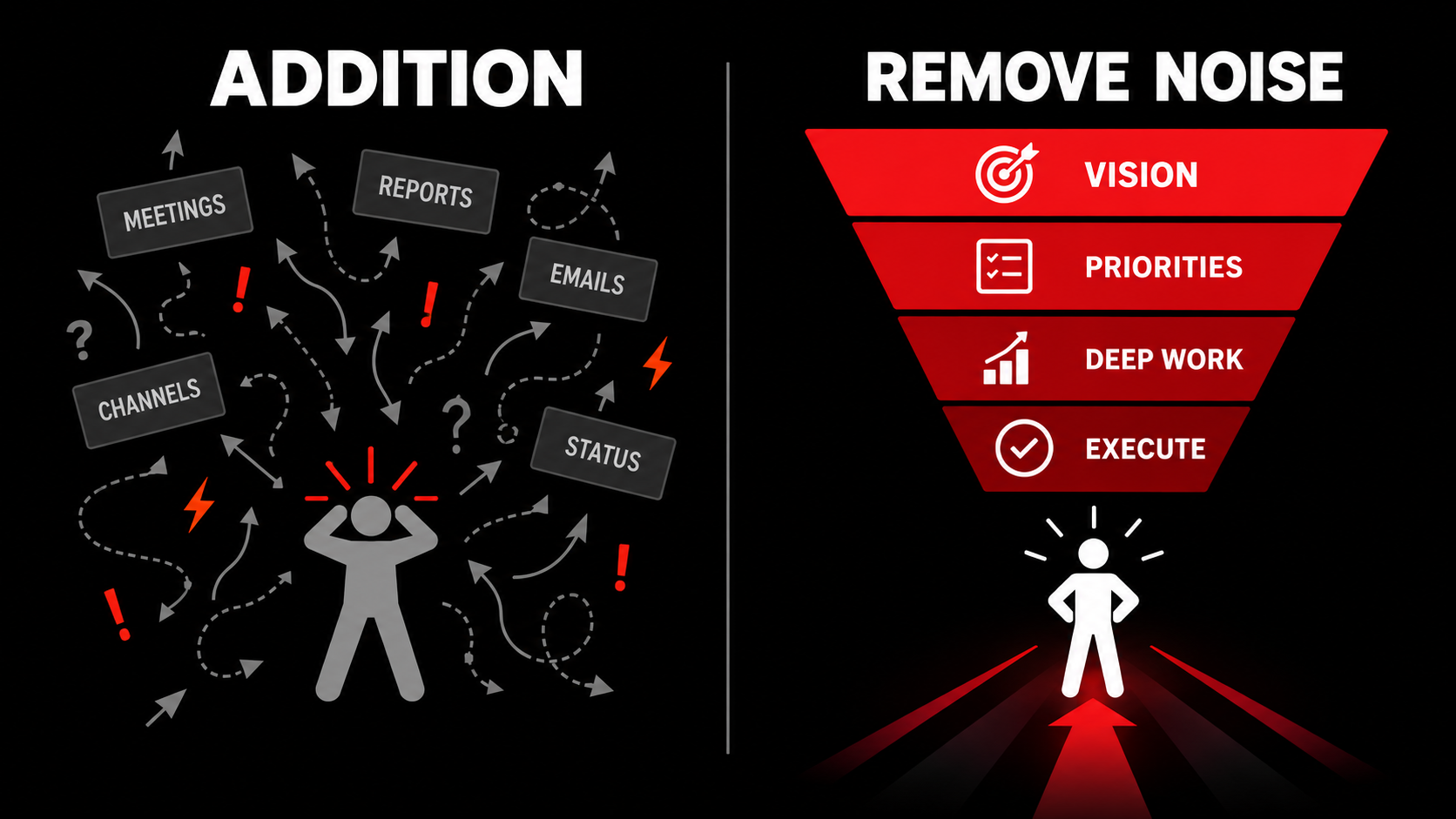
Every Monday morning, my TMI planner asks me two questions. The first is the one you would expect. What will I crush this week?
The second is the one that built my business. What noise will I remove?
Most people never ask the second question. They spend years adding and wonder why nothing compounds.
And this is absolutely essential to think through before a quarter begins. If your plan for the quarter is a list of things to add, read this before you commit to it. If it is not, close this now and get back to work. Very few people can say that honestly.
Addition Is the Default
Look at your marketing operation. I can guess how it grew.
Someone added a channel three years ago. Someone added a weekly report. Someone added a Monday status call, then a Thursday check-in to prepare for the Monday status call. Someone added a content type because a competitor was doing it. None of it was ever removed. It accumulated, like sediment.
Here is the math underneath all of that.
Your capacity for deep, original work is finite. I call it Creative Units, the daily reserve of focus you spend on work that requires your brain. Chris Bailey’s research shows our minds wander nearly half the working day. That leaves roughly four hours of focused output. Four hours to produce the content, the strategy, and the client thinking that generates revenue.
Every piece of noise you tolerate is a withdrawal from that account.
The report nobody reads costs Creative Units. The channel that has never produced a lead costs Creative Units. The meeting that could have been three sentences in an email costs Creative Units, plus twenty minutes of refocusing on either side of it.
You cannot add your way out of that. You can only subtract.
Why the Planner Forces the Question
When I built the Time Management Inverted 90-Day Planner, I put two prompts side by side on every weekly page. What Will I Crush? What Noise Will I Remove?
They are a pair on purpose.
A goal without a removal is a wish. Say your Big 3-5 weekly tactics include publishing two blog posts mapped to buyer intent and deploying schema markup, the structured code that helps Google and AI search engines read a page, across a client’s service pages. Good tactics. But if your calendar still holds eleven hours of accumulated noise, the tactics lose. Noise never has to justify itself. It is already on the schedule. It has tenure.
The removal question strips that tenure. Once a week, every recurring commitment has to re-earn its place.
Greg McKeown wrote in Essentialism that if you do not prioritize your life, someone else will. For marketers I would push it further. If you do not audit your noise, your noise becomes your strategy. Whatever fills the calendar is what the business actually does, whatever the plan says.
The Noise Audit
Here is the filter I run every Monday. It takes ten minutes.
Take every recurring item in your marketing operation. Every channel, every report, every meeting, every content type. Run each one through three questions.
Does this produce leads, revenue, or rankings I can point to? Not impressions. Not activity. Not “brand presence” nobody can measure. If you cannot draw a line from the item to a business outcome, mark it.
If this did not already exist, would I start it today? This is the question that kills zombies. Most noise survives on momentum, not merit. The social channel you opened in 2022. The 14-page monthly report for a client who reads the first paragraph. If you would not create it today, its only argument for existing is that it already exists. That is not an argument.
What would I do with the hours back? This is what makes removal real. Vague time savings evaporate. Claimed time compounds. Two hours reclaimed from a dead channel becomes two blog posts a month written for people ready to buy. Over a year, that is 24 pieces of content built to convert, funded entirely by subtraction.
Anything that fails the first question, dies at the second, and has a better use waiting at the third gets removed. Not paused. Not moved to Friday. Removed.
What I Removed, and What It Paid For
I do not write about frameworks I have not lived. Here is some of the noise I cut, and what each cut produced.
I removed constant email checking. I used to treat my inbox like a slot machine, pulling the handle forty times a day. Now email lives in two scheduled blocks. That one removal returned more Creative Units than any tool I have ever bought, and those units went into client content and the book I published this year.
I removed status meetings that existed to prove work was happening. They became short written summaries. Clients got more clarity, not less, and my team got their mornings back for deep work. Rankings come from deep work. Nobody ranked on page one because of a status call.
I removed reporting bloat. Client reports came down to the numbers that drive decisions. Leads, rankings, traffic to money pages, and what we are doing next. The hours saved went into moving those numbers.
The biggest removal of my career was an entire client profile. I have written about pivoting ContentMender toward hyperlocal lead gen for local service businesses. That was the noise question applied to business strategy. Enterprise bureaucracy failed all three questions. Approval chains and internal politics consumed focus without producing proportional outcomes, and I knew exactly what I would do with the capacity back. The local clients who took that capacity have multiplied their organic leads, and my margins came along.
Same question every time. Same result every time. Subtraction funded the growth.
The Part Nobody Says Out Loud
Removing noise feels wrong at first. I will not pretend otherwise.
Activity is a comfort. A full calendar looks like a successful business. An empty block feels like exposure. When you cancel the standing meeting or kill the dead channel, some part of you will say you are doing less.
You are not doing less. You are doing fewer things. Those are opposites.
Doing less means output drops. Doing fewer things means the same finite Creative Units concentrate on work that compounds. One is decline. The other is focus. The whole Time Management Inverted framework exists because I watched talented people, myself included for years, confuse the two.
Cal Newport calls deep work a superpower because it is scarce. It is scarce because almost nobody protects it. The Monday removal question is how you protect it. Not with willpower. With a standing appointment to subtract.
Before The Next Quarter
Do not overhaul anything. Overhauls die quickly.
Before the next quarter starts, answer one question. What is one piece of noise in your marketing operation that fails all three audit questions?
One report. One meeting. One channel. One content type you produce out of habit.
Remove it. Give the reclaimed hours a specific job tied to leads or rankings. Then run the question again next Monday, because this compounds. It is not a one-time purge.
You are free to keep everything exactly as it is. Most people will, and their upcoming quarter will look a lot like their current quarter.
The marketers pulling ahead right now are not the ones doing the most. They decided, on purpose, what they would stop doing.